Understanding the Wildland-Urban Interface (WUI) in Colorado Springs
Living in Colorado Springs means waking up to crisp Colorado air, panoramic views of Pikes Peak, and a community surrounded by trails, forests, and open spaces. But this incredible lifestyle comes with a unique challenge: the risk of wildfire. Many neighborhoods across the region sit within the Wildland-Urban Interface (WUI) – the areas where homes meet or intermingle with Colorado’s wild landscapes.
At first glance, living in a WUI zone may sound like an added risk. After all, wildfires have shaped much of Colorado Springs’ history, from the Waldo Canyon Fire in 2012 to the Black Forest Fire in 2013. But here’s the surprising truth: being located in a designated WUI zone can actually benefit homeowners. Thanks to forward-thinking planning, fire-mitigation programs, and strong community partnerships, residents enjoy added safety and resources.
At Decks by Schmillen, we’ve worked with numerous homeowners located within the Wildland-Urban Interface zones of Colorado Springs. Building in these areas requires extra attention to fire safety and compliance with strict codes. Our team goes beyond simply meeting WUI requirements – we design and construct decks that exceed fire safety safety standards in many instances, while providing lasting beauty and functionality.
By combining Fortress Evolutions steel deck framing, fire-rated composite decking, and durable steel railings, we create outdoor living spaces that are not only low-maintenance but also highly resistant to wildfire risks. These materials ensure straight, stable framing, Class A fire ratings, and long-term durability – all while giving homeowners peace of mind in fire-prone areas.
If you live in a WUI zone, we’ll help you design a deck that balances safety, performance, and style – so you can enjoy your outdoor space with confidence for years to come.
What is the Wildland-Urban Interface?
The Wildland-Urban Interface is where residential or commercial development borders or overlaps with natural vegetation that could fuel a wildfire. In Colorado Springs, this includes foothill neighborhoods, areas near canyon systems, and developments built into or alongside forested terrain.
According to the Colorado Springs Fire Department, more than 32,000 homes sit inside the city’s WUI zones. Recognizing this, the city has developed some of the most proactive wildfire mitigation programs in the nation, making these neighborhoods both safer and more resilient.
Why Wildfire Awareness Benefits Homeowners
Instead of treating wildfires as an unpredictable danger, Colorado Springs has leaned into preparedness. That’s where the benefits of living in a WUI neighborhood shine through: homeowners gain safety, resources, and even community advantages that other neighborhoods may not have.
Let’s break down the main benefits:
1. Increased Safety Measures: One of the most significant homeowner benefits of living in a WUI zone is enhanced fire protection. Because these areas are recognized as higher risk, the city invests more in:
– Defensible Space Programs: Homeowners are educated and supported in creating buffer zones by thinning trees, trimming branches, and maintaining vegetation around their homes.
– Fire Resistant Building Requirements: Many WUI neighborhoods must follow stricter codes for roofs, siding, and decking materials, making homes more resilient.
– Regular Risk Awareness: Fire officials often work directly with residents to evaluate individual properties and provide customized recommendations.
The result? Homes are statistically safer when wildfire events occur because preventative steps have already been taken.
2. Improved Property Value: It might sound counterintuitive, but homes in WUI neighborhoods often carry higher property values. Why?
– Scenic Locations: These homes are typically in foothill or forested areas, offering panoramic views, privacy, and access to trails.
– Mitigation Confidence: Buyers increasingly value homes that have already undergone wildfire mitigation and adhere to fire-wise standards.
– Long-Term Investment: Proactive community safety programs provide reassurance, which helps stabilize or boost real estate values.
For many homeowners, living in the WUI zones combine both the Colorado lifestyle and the peace of mind that steps are being taken to reduce wildfire risks.
3. Access to Resources and Support: Colorado Springs homeowners in WUI zones don’t have to go it alone. They gain access to specialized city programs designed to support wildfire safety.
– Chipping Program: The city offers free curbside chipping of tree branches and vegetation to encourage ongoing yard maintenance. You can find more information here: https://www.coswildfireready.org/neighborhood-chipping-program
– Neighborhood Wildfire Mitigation Grants: Community groups can apply for funding to cover vegetation removal, fire-resistant landscaping, and neighborhood-wide fire mitigation projects.
– Educational Workshops: Homeowners can attend seminars to learn about fire-safe building materials, landscaping strategies, and emergency preparedness. You can find more information here: https://www.coswildfireready.org/education-services
4. Insurance Incentives: Another major advantage is some insurance companies reward homeowners for fire mitigation.
– Reduced Premiums : Many providers offer reduced premiums for homes in fire-wise communities or those with documented mitigation work.
– Direct Financial Benefits : Upgrades like fire-resistant roofing, non-combustible siding, and covered soffits can translate into direct financial benefits.
– Long-Term Savings : By participating in city or neighborhood-wide mitigation efforts, homeowners can demonstrate reduced risk – making their properties more attractive to insurers.
For homeowners, this means that upfront investments in mitigation can pay off with long-term cost savings.
5. Stronger Community Preparedness: WUI neighborhoods foster a sense of collective responsibility. Because wildfire risk is shared, communities often unite to prepare:
– Neighborhood Fire-Wise Groups: Homeowners collaborate to manage vegetation and promote safety across property lines.
– Evacuation Planning: Communities are more likely to have well-coordinated plans, making emergency responses faster and more efficient. You can visit the website page for preparation at: https://www.coswildfireready.org/evacuation-preparedness
– Shared Resources: Neighbors often pool tools, equipment, and knowledge to make fire mitigation easier and more affordable.
This level of organization not only makes communities more resilient but also strengthens neighbor-to-neighbor relationships.
Real-Life Examples in Colorado Springs
– Waldo Canyon Fire (2012): Although devastating, neighborhoods that had implemented defensible space practices fared far better than those that hadn’t. The fire became a real-world demonstration of how mitigation directly impacts survival.
– Black Forest Fire (2013): Mitigated homes surrounded by thinned trees and cleared vegetation were often left standing when nearby properties were lost.
– Current WUI Programs: Today, Colorado Springs is nationally recognized as a leader in wildfire mitigation, with entire neighborhoods designated as “Firewise USA Communities”.
These examples show that while wildfire risk is real, preparedness can dramatically change outcomes. The Colorado Springs Wildfire Ready website has a page that discusses lessons learned from wildfires: https://www.coswildfireready.org/lessons-learned-from-wildfires
Striking a Balance Between Nature and Safety
Living in a WUI zone isn’t about choosing between natural beauty and safety – it’s about balancing the two. Homeowners in Colorado Springs benefit from:
– The Colorado lifestyle of forested backdrops, wildlife sightings, and trail access.
– The peace of mind that comes with fire-resistant construction, defensible space, and a well-prepared community.
– The long-term protection of property values and insurance opportunities.
Far from being a liability, living in a WUI zone empowers homeowners to embrace both the natural beauty of Colorado and the security of fire-mitigation efforts.
Why WUI is an Asset for Colorado Springs Homeowners
The Wildland-Urban Interface in Colorado Springs is not just a line drawn on a map – it’s a framework for safer, more resilient communities. Homeowners gain:
– Stronger protections through city-let mitigation programs.
– Higher property appeal thanks to scenic locations and wildfire readiness.
– Community support and resources that make safety easier to obtain and more affordable for homeowners.
– Financial benefits through insurance incentives and long-term value stability.
For homeowners, WUI represents not just a place to live but a safer, smarter, and more sustainable way to enjoy everything Colorado Springs has to offer.
For more information on the Colorado Springs WUI zones and regulations, please visit their website at: https://www.coswildfireready.org.
Create a Safer Outdoor Living Space with Fire-Resistant Design
At Decks by Schmillen, we understand the importance of building outdoor spaces that not only look beautiful but also stand up to Colorado’s unique challenges – including wildfire risk. By using Fortress Evolutions steel deck framing, fire-resistant composite decking, and steel and aluminum deck railings, we help homeowners in Colorado Springs WUI zones to enjoy peace of mind while upgrading their outdoor lifestyle.
Whether you’re considering a low-maintenance composite deck, a covered patio, or a custom outdoor-retreat, our team can design your dream outdoor living space with safety and beauty in mind.
Contact us today to schedule a consultation and learn how we can create a fire-wise outdoor living space that enhances your home’s value, safety, and your family’s enjoyment!
Below are a couple examples of outdoor living areas that we have built in WUI zones.
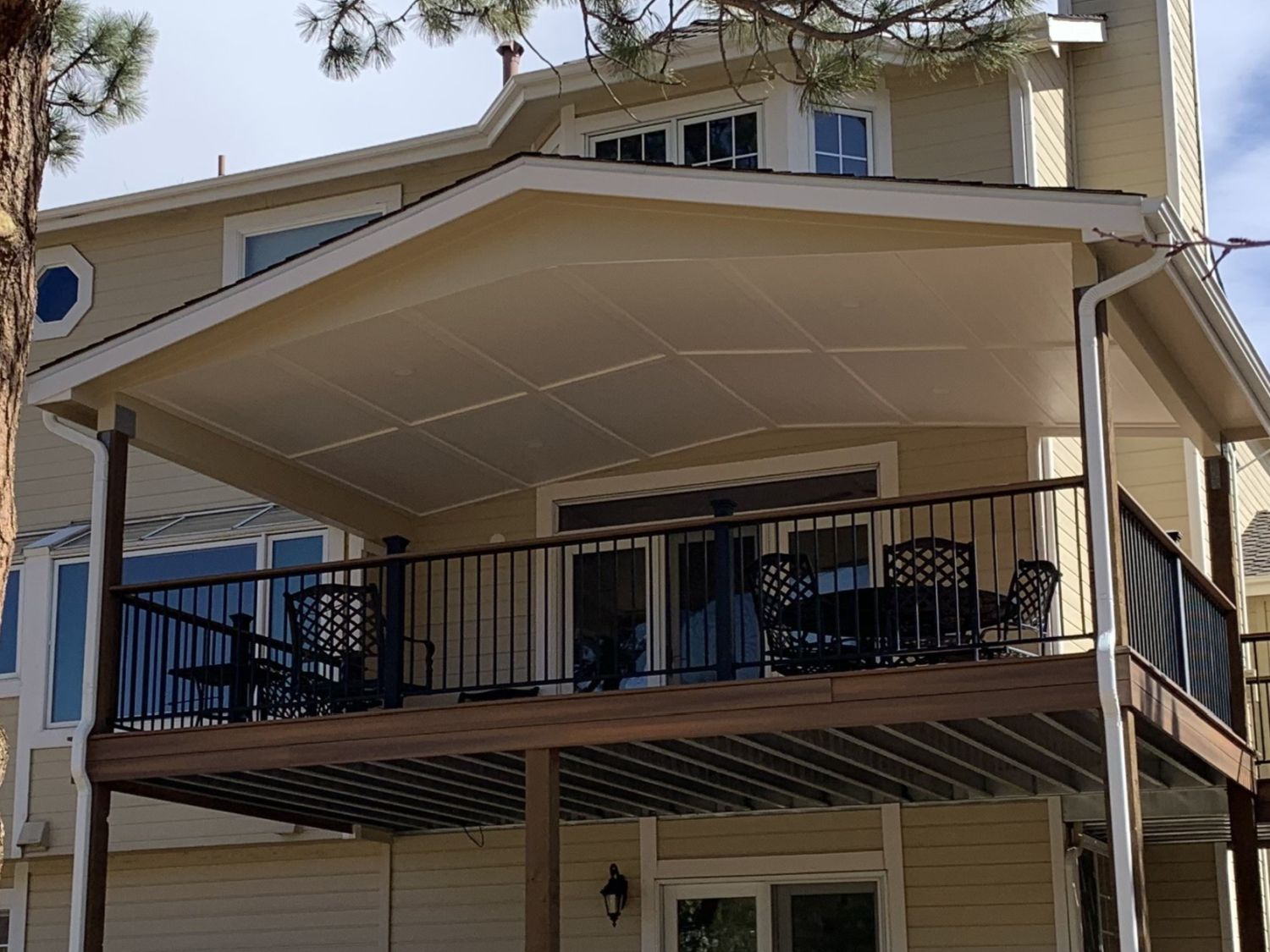
We built a gabled deck cover over an existing deck in a WUI zone. We designed it using James Hardie panels for the ceiling in order to meet the fire codes.

In order to meet WUI regulations we used fire-rated composite decking material for these two elevated deck.