The Ultimate Guide to Steel Deck Framing:
Fire Smart, WUI-Approved, Strength, and Longevity
If you live in Colorado Springs or any of the surrounding communities, there’s a good chance you’ve heard the term WUI – the Wildland Urban Interface. WUI consists of the zones where homes and neighborhoods meet (or blend into) natural vegetation, open space, or forested areas. In WUI areas, fire mitigation isn’t a “nice-to-have”. It’s a practical design priority that can influence everything from your roofing and landscaping to – yes – your deck.
When homeowners think about deck upgrades, they usually start with what they can see: decking color, railing style; lighting; stairs; and maybe a cover. But for fire mitigation, one of the most important deck decisions is what you don’t see once the job is finished: the framing.
Traditional decks are often built with pressure-treated KDAT framing. Wood framing is safe and structurally sound when designed and built properly, but from a fire-mitigation perspective it is still combustible material under the deck – an area that can be vulnerable to embers and radiant heat during a wildfire.
In this blog, we will walk through everything you need to know about steel deck framing – from what it is and why it matters, to performance advantages, safety benefits for homes in wildfire-prone areas, environmental considerations, long-term value, installation insights, and why it’s becoming the preferred choice for homeowners looking for high-performance outdoor living spaces.
What is Steel Deck Framing
Deck framing is the structural skeleton of any deck. It consists of the beams, joists, posts, and support members that create the framework on which the decking boards, railing, and additional features are attached. Traditionally made from wood, deck framing determines how stable, level, and durable a deck will be over time.
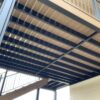
Steel deck framing uses engineered metal components – typically high-strength steel members – in place of or in combination with wood. Unlike lumber, steel does not suffer from knots, moisture movement, or natural degradation. Steel deck frames are engineered and precision-manufactured to deliver consistent strength, straightness, and dimensional stability that wood simply cannot match. (visit our Steel Deck Framing page)
The Core Advantages of Steel Deck Framing
1. Superior Structural Strength and Support
Steel delivers remarkable structural performance compared with wood. It’s inherent strength allows for:
- Higher load capacity – steel can support more weight per square foot than comparably sized wood framing.
- Longer spans between posts – meaning fewer posts interrupting views and a cleaner deck profile.
- Greater dimensional stability – steel does not warp, twist, bow, or settle the way wood sometimes does under changing conditions.
For homeowners planning expansive outdoor spaces, multi-level decks, heavy features like hot tubs, outdoor kitchens, or built-in seating, steel framing offers the kind of strength needed.

2. Built to Withstand Weather and Climate
Wood framing may react to moisture, weather swings, and pests. Even “pressure-treated” lumber is still wood: it may dry, shrink, swell, and might develop rot, cracks, and insect vulnerability over time.
Steel framing, when properly protected with coatings or finishes, resists:
- Moisture and rain exposure
- Freeze/thaw cycles
- Insect damage and mold growth
- Warping due to heat or humidity fluctuations
This resilience translates to fewer callbacks for repairs and a deck that stays flat, level, and functional for decades with the problems associated with possible wood shrinkage or deterioration.
3. Fire Safety and WUI-Compliance
One of the most important evolving factors in deck design – especially for homes in or near Wildland Urban Interface (WUI) – is fire risk mitigation. The WUI refers to areas where homes meet or are located within wildland vegetation, increasing wildfire risk. Residents in these zones are often advised or required to adopt materials and design methods that reduce ignition potential and fire spread.
Steel is non-combustible, meaning it does not burn, feed a fire, or contribute fuel in the way wood does. This yields significant safety advantages:
- Enhanced fire resistance under high heat conditions
- Better compliance with fire-ready building implemented for WUI properties
- Reduced risk of deck ignition during fire events
The reality is, wood deck framing – while a viable option for many homeowners – remains combustible and may not offer the same level of fire performance that non-combustible steel does in wildfire-prone regions.
4. Accuracy and Consistency at Every Build
Each steel frame is engineered to exact standards and the components are manufactured to strict tolerances. Each beam, joist, and connector is designed for a specific deck and arrives on the site true to size, free of inconsistencies – knots, splits, moisture variations – that can come with natural wood lumber.
What does this mean on the job?
- Faster installation with fewer field adjustments
- Levels and lines that stay straight through decades of use
- Improved board alignment and fit of decking materials
This level of precision not only improves performance but also makes construction more predictable and often more efficient.
The Steel Deck Framing Advantage: What Homeowners Gain
Longevity that Protects Your Investment
A deck is a long-term investment in your home’s value and your lifestyle enjoyment. Because steel deck framing resists many of the degradation mechanisms that can shorten the life of wood deck framing, it reduces possible long-term repair costs and offers peace of mind that structural issues are less likely to surface over time. Even in climates with extreme temperature swings, steel requires minimal intervention over years of use.
Performance in Harsh Environments
We live in an area with aggressive weather – heavy snow loads, strong winds, frequent moisture changes – and steel deck framing delivers resistance to deflection underload, stability in extreme dryness or humidity, and consistent performance through our freeze/thaw cycles. This makes steel an ideal choice across Colorado’s climates, from high-altitude mountain homes to the dry high plains.
Fire-Sensitive Properties: Why Steel Matters in WUI and High-Risk Zones
For properties near forests, brushlands, or open grasslands, thinking about fire resistance isn’t just theoretical – it’s practical safety planning. At this time, traditional pressure-treated wood deck framing is allowable by Colorado Springs WUI. However, it is combustible and could pose a risk during wildfire events. In contrast:
- Steel deck framing is non-combustible, meaning it will not ignite.
- Steel resists direct flame exposure and reduces fuel sources attached to your home.
Environmental Considerations: Sustainability and Lifestyle
Steel is highly recyclable, meaning that at the end of its life it can be reclaimed and reused. In contrast, wood framing – especially when treated with chemicals – May not be recyclable and often ends up in a landfill. Additonally:
- Steel framing reduces waste on the job site.
- Engineered steel components minimize material variability.
- Long service life reduces the frequency of replacement – lowering overall resource use.
For environmentally conscious homeowners, these factors can make steel deck framing an attractive choice.
Fire-Sensitive Properties: Why Steel Matters in WUI and High-Risk Zones
For properties near forests, brushlands, or open grasslands, thinking about fire resistance isn’t just theoretical – it’s practical safety planning. At this time, traditional pressure-treated wood deck framing is allowable by Colorado Springs WUI. However, it is combustible and could pose a risk during wildfire events. In contrast:
- Steel deck framing is non-combustible, meaning it will not ignite.
- Steel resists direct flame exposure and reduces fuel sources attached to your home.

-
Environmental Considerations: Sustainability and Lifestyle
Steel is highly recyclable, meaning that at the end of its life it can be reclaimed and reused. In contrast, wood framing – especially when treated with chemicals – May not be recyclable and often ends up in a landfill. Additonally:
- Steel framing reduces waste on the job site.
- Engineered steel components minimize material variability.
- Long service life reduces the frequency of replacement – lowering overall resource use.
For environmentally conscious homeowners, these factors can make steel deck framing an attractive choice.
Understanding the Installation Process
Installing steel deck framing requires precision, expertise, and a solid understanding of structural loads. While every project is unique, the general process looks like this:
- Planning and Design – the framing layout is designed by an engineer based on deck size, and local building code requirements.
- Preparation and Footings – Footings and support posts are installed according to plan, ensuring a stable foundation for the frame.
- Frame Assembly – Steel beams and joists are arranged and connected, using fasteners designed for steel deck frame.
- Decking Attachment – Once the frame is secure and level, decking boards – whether wood, composite, or other materials – are installed.
- Finishing Touches – Railings, stairs, lighting, and other design elements are added to complete the outdoor living space.
Because steel arrives straight and dimensionally stable, installers spend less time cutting wood beams and joists to size and they will not have to order additional material if a beam or joist arrives bowed.
When Wood Framing Can Still be the Right Choice
Steel framing is a premium option. For some wood projects, even those in WUI zones, wood framing can still be a smart fit. A high-quality wood-framed deck can absolutely be safe, strong, long-lasting, and attractive – especially when the design is well planned and the workmanship is strong.
The goal of this article is not “Steel Good, Wood Bad”. The goal is to match the structure of a project to our clients’ priorities.
How to Compare Estimates
When you evaluate estimates, don’t just compare the bottom line number. You want to ensure that the bids are apples-to-apples. Make sure both bids match on:
- Are plans and permit included
- Measurements of the deck
- Manufacturer and line of decking material, type of fasteners
- Type of steel deck framing – galvanized vs powder-coated
- Number of steps, stair width, open vs closed, and landings
- Railing manufacturer and style
- Any additional upgrades or add-ons (Such as lights, drink cap,
Conclusion
Steel deck framing represents a significant upgrade over traditional wood framing – offering unmatched stability, durability, fire resistance, and long-term value. It’s a choice that makes sense not only for large and feature-rich deck projects, but also for homeowners concerned with longevity, safety, and performance – especially in wild-fire prone WUI areas.
If you’re planning a new deck or outdoor living space, choosing a steel framed structure today means a stronger and more resilient deck for years to come. You can view past projects that have been built using steel deck framing at our Steel Deck Framing page.
Decks by Schmillen has extensive experience working with steel deck framing, and we can help you design and build the outdoor living space of your dreams – 719-440-6966