

Colorado Springs WUI Deck Requirements: What Homeowners Need to Know
Picture your new deck: summer dinners, comfortable seating, and a front-row view of Pikes Peak. Choosing the size, layout, and materials is the fun part. But if your home sits in the Colorado Springs Wildland Urban Interface (WUI), planning a deck also means planning around the city’s wildfire rules.
Those rules can affect the boards you walk on, your stair treads, what’s around the deck, covers and overhead structures, and the landscaping near your project. As a local Colorado Springs deck builder, Decks by Schmillen helps homeowners understand these requirements before design decisions are locked in, so there are no surprises at plan review or inspection.
Please Note: Decks by Schmillen builds decks. We do not perform landscaping or wildfire mitigation work. If the fire department requires vegetation removal, tree trimming, or ground-cover changes, homeowners will need to handle that work themselves or hire a landscaper or mitigation contractor.
What Are the Colorado Springs WUI Rules?
The Wildland Urban Interface is where homes meet or mix with grass, brush, and trees that can fuel a wildfire. In Colorado Springs that includes much of the west side foothills and, under the updated map, can include some grassland areas on the city’s eastern side.
On April 28,2026, Colorado Springs City Council passed Ordinance 26-18, which replaced Appendix K of the city’s Fire Code with the Colorado Springs Wildfire Resiliency Requirements. The update brings the city in line with the statewide Colorado Wildfire Resiliency Code and uses a locally developed wildfire risk map. The new rules took effect June 30,2026.
For a homeowner planning a deck, the practical question is simple: Which requirements apply to your address and your project?
Start With Your Address: Are You in the City WUI?
Before final design and material choices, confirm two things:
- Is your home inside Colorado Springs city limits? A Colorado Springs mailing address doesn’t guarantee it. Many homes with a Colorado Springs address are in unincorporated El Paso County.
- Is your property in a mapped wildfire risk area, and is it Class I or Class II? You can look up your address on the Colorado Springs View wildfire risk map.
Neighborhoods such as Broadmoor, Cheyenne Mountain, Skyway, Cedar Heights, Mountain Shadows, Peregrine, Northgate, and Flying Horse, as well as newer east-side areas, may fall within mapped areas. Always check the specific parcel.
When you contact us, we can start with your address and a few questions. Are you replacing an existing deck, making it larger, adding stairs, or planning a cover? That tells us which requirements are likely to apply before we put a design on paper.
Outside Colorado Springs City Limits?
We also build in Black Forest, Falcon, Peyton, Monument, and throughout El Paso County, where Colorado Springs Appendix K does not apply. Different rules may still apply there:
- Unincorporated El Paso County adopted the state’s 2025 Colorado Wildfire Resiliency Code map and requirements (Appendix E of the the County Land Development Code) for areas inside the WUI but outside a fire protection district.
- Fire protection districts and towns (such as Monument Fire District and Town of Monument) adopt and enforce their own versions of the state code.
We’ll help you identify the right jurisdiction early so the deck is designed to the correct standard.
Why Do the WUI Rules Focus on Decks?
A deck is large horizontal surface where wind-blown embers can land and collect. In a Colorado Springs Fire Board of Appeals discussion, a fire official explained that lessons from the 2012 Waldo Canyon Fire shaped the city’s deck rules. Embers collected on decking, ignited, and helped fire to homes. The official noted that vertical and structural members, like deck framing, are less likely to collect embers.
That’s why different parts of a deck can have different material requirements. Deck boards, stair treads, framing, railings, and any overhead cover each play a different role, so approving one material doesn’t settle the requirements for the whole structure.
Your New Deck May Need Different Materials Than Your Old One
If you’re replacing an older wood deck, you may expect to use the same type of boards. Under the updated rules, that may not be allowed. An existing wood deck, or a neighbor’s deck built just a few years ago, doesn’t establish what will be approved for your project today. Your property’s classification and the scope of your work determine the requirements.
We walk you through decking options so you can choose the look, maintenance level, and budget you want while meeting the fire department’s requirements.
What Decking is Allowed in the Colorado Springs WUI?
For Class II unenclosed decks, Appendix K covers both the deck surface and step treads. They must be built with one of the following:
- Class A rated material, or
- Composite decking with a minimum Class B rating (allowed as an exception), or
- Ignition-resistant building materials that meet the code.
Wood decking surfaces are not allowed on Class II decks. Wood can still be used for large structural components (such as framing) and railings.
The decking surface rules above are in the Class II provisions. If your property is Class I, confirm with CSFD Fire Construction Services which deck provisions apply.
The exact product matters. “Composite decking” is a product category, not a fire rating. Not every composite board carries a Class B or Class A rating. We identify the specific manufacturer and product line early, and the product documentation submitted for review must match what is actually installed. You still choose based on appearance, maintenance, and budget, just from products that meet Appendix K standards and are accepted by the Colorado Springs Fire Department during plan review.
Does Every Part of the Deck Have to be Composite?
No. The rules treat walking surfaces differently from other components. Under the Class II decking provision (Appendix K, Section K109.2.7), wood is prohibited for the decking surface but allowed for large structural members and railings. That doesn’t mean every wood component is acceptable in every design, because the complete project still has to meet all applicable requirements.
Many WUI decks combine materials: rated composite or PVC boards on top, with wood or steel deck framing below and metal deck railings around the edges. Your proposal from us will spell out what’s used for the deck boards, stairs, framing, railings, skirting, and any cover before you commit.
The Area Under and Around Your Deck
A wildfire review looks at the ground below and right around your deck, not just the deck itself. Both wildfire classes include immediate zone (0-5 foot) requirements that call for noncombustible surfaces such as gravel, rock, concrete, or pavers. There are limited exceptions, such as approved low-flammability plants.
This can affect backyards with bark mulch, shrubs, or planting beds where the deck will go. If you plan to build next an existing plant bed, both the design and that bed should be reviewed before work begins.
Fences and retaining walls within 8 feet of the home must also be noncombustible or ignition-resistant. Keep this in mind for deck skirting, privacy screens, and gates that tie into the deck.
Decks by Schmillen does not remove vegetation, replace landscaping, or install landscape ground cover. Before you accept a landscape estimate, make sure the provider understands the specific requirements for your property, because a general yard clean up may not cover everything needed for approval.
Required Yard Work May Extend Beyond the Deck
For additions and alterations, Appendix K applies fuels-management requirements within a 30-foot radius of the work’s perimeter, or to the property line if that’s closer, based on your parcel’s classification. In plain terms, a deck project can require attention to landscaping well beyond the deck’s footprint.
If you’re extending a deck farther into the yard, ask the fire department where the 30 feet will be measured from and what vegetation needs attention. Do this early, because landscaping can affect both your budget and inspection timing. Don’t assume every nearby tree must go. Have conditions reviewed, including any exceptions, before authorizing major cutting.
Planning a Covered Deck?
Deck covers, roofs, and other overhead structures add construction details. The Class II provisions specifically address patio and deck cover, and Appendix K also covers underfloor enclosures and projections (Appendix K, Sections K109.2.1, K109.2.6, K109.2.8).
Tell us up front if you want a roof, pergola, or other overhead feature, because it changes what is reviewed. The plans need to address the entire structure: supports, the connection to your home, the underside, and protection details. Choosing approved deck boards is only one piece.

This custom outdoor living space in Mountain Shadows features a shed-roof style deck cover with a WUI-approved stucco ceiling.
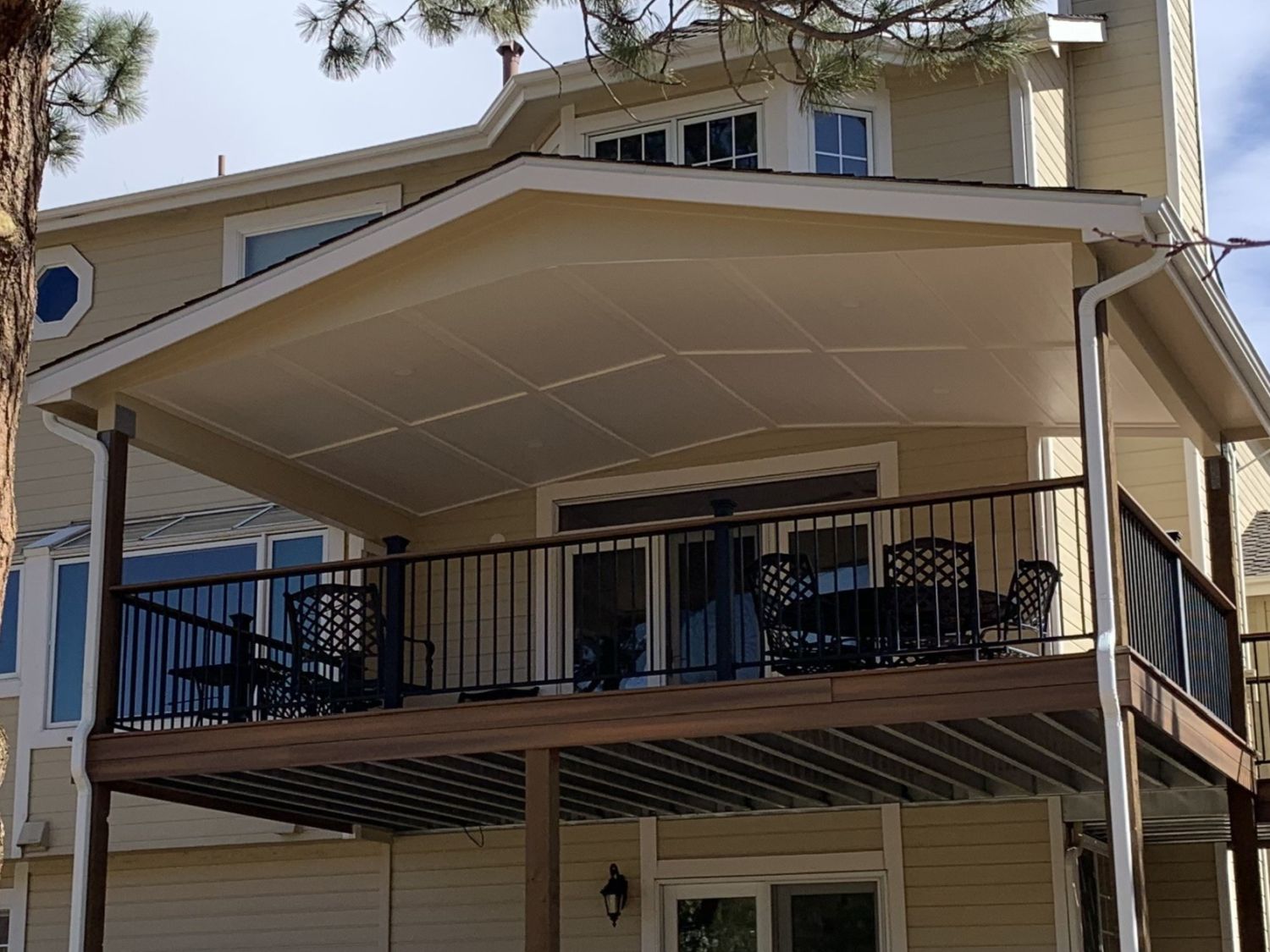
Our clients to chose to use James Hardie panels (WUI-approved) for their vaulted ceiling, creating a unique and classic look.
Replacing or Repairing an Old Deck Can Trigger Review
Many homeowners assume that rebuilding a deck in the same location lets them reuse the same materials and details. Confirm that before work begins.
Under Ordinance 26-18, the Class II triggers for existing decks include alterations to the main structural members and repair or construction that required a PPRBD permit. The ordinance defines deck maintenance as like-for-like replacement of work or defective walking-surface parts without changing the footprint (Sections K102.1 and K109.2.1).
Swapping a few damaged boards and rebuilding an entire deck are very different scopes. Describe exactly what will be removed, kept, and rebuilt. Don’t rely on the word “repair” to avoid review, because the work is judged by its actual scope. (See our Deck Repairs page for more.)
Inspections and Scheduling
Class II projects have review and inspection steps that will include a final fire inspection (Ordinance 26-18, Section K101.7). Confirm the specific stages for your deck with the responsible officials.
When landscaping is handled separately, coordination is key. Before construction is scheduled, make sure you know:
- What mitigation or landscaping work is required
- Who will do it
- When it must be finished
- Which approvals or inspections depend on it
If an inspection depends on landscape work that isn’t done yet, the project may stall until it is.
Budget for the Complete Project
Think about the total cost of getting to an approved, finished deck. Our proposals cover the construction work in our agreement. Depending on your property, your budget may also need to include tree removal or trimming, vegetation removal, mulch replacement, ground-cover changes, or other mitigation. Get pricing on those items once the requirements are known. If you’re comparing two deck sizes or layouts, weight the landscape work for each alongside the construction cost.
Frequently Asked Questions
Can I build a wood deck in the Colorado Springs WUI?
On Class II properties, wood is not allowed for the deck surface or stair treads. Wood is still allowed for large structural framing and railings. Check your property’s classification on the City’s Springs View map.
When did the new Colorado Springs WUI rules take effect?
Ordinance 26-18 was passed on April 28, 2026 and took effect June 30, 2026. It replaced Appendix K of the City Fire Code.
Is all composite decking WUI-compliant?
No. On Class II decks, composite boards need at least a Class B fire rating, or you can use a Class A rated product. Ratings vary by manufacturer and product line, so the exact board matters.
Do I need to bring my old deck up to code if I replace some boards?
Like-for-like replacement of work or defective walking-surface parts without changing the footprint is considered maintenance. Altering the main structural members, or doing work that needs a PPRBD permit, can trigger the WUI requirements.
Does the WUI code affect my landscaping?
Yes. The 0 – 5 foot immediate zone needs noncombustible surfaces, and fuels-management rules can extend 30 feet from the work area. Decks by Schmillen does not do landscaping, so homeowners arrange that work separately.
Do the same rules apply in Black Forest, Falcon, or Monument?
No. Those areas are outside Colorado Springs city limits. Unincorporated El Paso County, local fire districts, and towns like Monument each enforce their own version of the Colorado Wildfire Resiliency Code.
Where to Get Property-Specific Answers
- Wildfire construction questions: Colorado Springs Fire Department, Fire Construction Services, 719-385-7493
- Vegetation & mitigation questions / free on-site consultation: CSFD Wildfire Mitigation, 719-385-5982
- Building permit questions:Pikes Peak Regional Building Department (PPRBD), 719-327-2880
- Unincorporated El Paso County: El Paso County Planning & Community Development, 719-520-6300
Build Your WUI-Compliant Deck With a Local Expert
Decks by Schmillen is a family-owned Colorado Springs deck builder serving the city and El Paso County, from Broadmoor and Northgate to Black Forest, Falcon, and Monument. Share your address and your ideas, and we’ll talk through the construction scope, material options that meet the WUI rules, and the decisions that need to be made before building begins.
Call 719-440-6966 for an estimate!
